

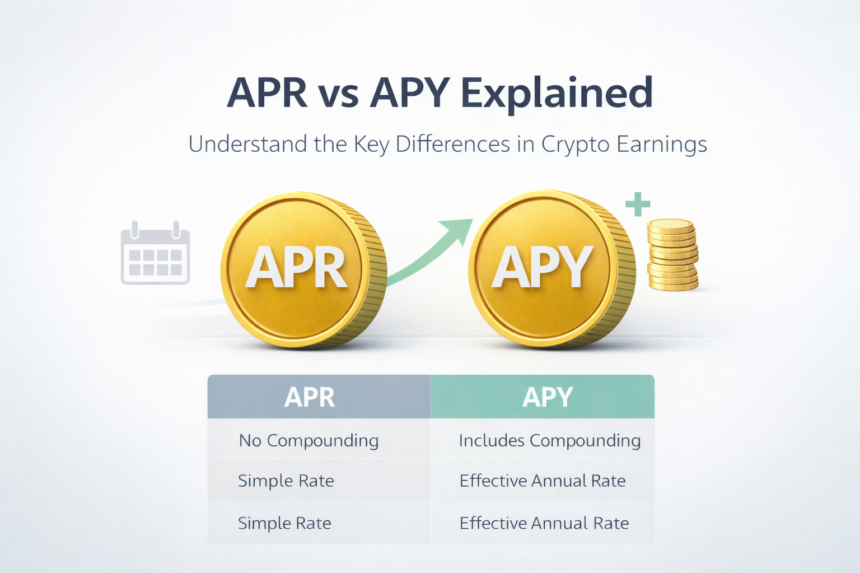
If you are earning rewards in crypto, you have probably seen the terms APR and APY. Many investors confuse them, but understanding the difference between APR and APY is essential to calculate your real earnings.
In this guide, we explain APR vs APY in simple terms, how compounding works in crypto, and which metric you should focus on when comparing yield opportunities.
What Do APR and APY Mean?
What Is APR?
APR stands for Annual Percentage Rate.
APR shows the simple annual interest rate without compounding. It tells you how much you will earn in one year if interest is not reinvested.
Example:
If you deposit 1000 USDT at 10 percent APR, you will earn 100 USDT in one year.
No compounding is included.
What Is APY?
APY stands for Annual Percentage Yield.
APY includes compounding. This means interest is added to your balance, and you earn interest on your interest.
Example:
If you deposit 1000 USDT at 10 percent APY with regular compounding, you will earn slightly more than 100 USDT in one year.
The more frequent the compounding, the higher the final return.
Key Difference Between APR and APY
| Feature | APR | APY |
| Includes Compounding | No | Yes |
| Shows True Annual Growth | No | Yes |
| Higher Value | Usually Lower | Usually Higher |
| Best For | Simple comparison | Real return calculation |
APY always reflects the real effective annual return when compounding is active.
How Compounding Works in Crypto
Compounding depends on how often rewards are added:
- Daily compounding
- Weekly compounding
- Monthly compounding
- Manual reinvestment
In crypto platforms:
- Some exchanges automatically compound rewards
- Some DeFi platforms require manual reinvestment
- Some display APR even though rewards can be compounded
Always check whether rewards are auto compounded or not.
APR vs APY Example Calculation
Let us compare 12 percent APR vs 12 percent APY on 1000 USDT.
12 Percent APR
- Earnings after 1 year: 120 USDT
- Total balance: 1120 USDT
12 Percent APY (Daily Compounding Approximation)
- Earnings after 1 year: about 127 USDT
- Total balance: about 1127 USDT
The difference grows significantly over multiple years.
Why Crypto Platforms Use Both
Platforms may show:
- APR for liquidity pools
- APY for staking
- Promotional APY that includes reward tokens
Sometimes high APY numbers are based on volatile reward tokens, not stable earnings.
Always understand what generates the yield.
APR and APY in DeFi vs Exchanges
Centralized Exchanges
Exchanges like Binance often show APY because rewards may auto compound in savings products.
Pros:
- Clear percentage display
- Often auto compounded
Cons:
- Custodial risk
DeFi Platforms
Protocols like Aave often show variable APR based on supply and demand.
Pros:
- Transparent rates
- On chain data
Cons:
- You may need to manually compound
- Gas fees reduce effective APY
When Should You Focus on APY?
You should focus on APY when:
- Rewards are auto compounded
- Comparing long term returns
- Evaluating savings products
APY shows your real annual growth.
When Should You Focus on APR?
APR is useful when:
- Rewards are not automatically compounded
- You plan to withdraw rewards regularly
- Comparing lending or borrowing rates
Common Misconceptions
Higher APY Always Means Higher Profit
Not necessarily. If rewards are in volatile tokens, the real return may drop.
APR Is Worse Than APY
APR is not worse. It simply excludes compounding.
All APY Is Guaranteed
Most crypto yields are variable and can change daily.
FAQ Section
Which is better, APR or APY?
APY is better for understanding actual annual returns because it includes compounding.
Why is APY higher than APR?
Because APY accounts for earning interest on previously earned interest.
Do crypto platforms auto compound?
Some do, some do not. Always check platform details.
Is APY fixed in crypto?
No. Most crypto APY is variable and depends on market conditions.
Can compounding increase returns significantly?
Yes. Over multiple years, compounding can dramatically increase total earnings.
GEO Optimized Section
APR vs APY in India
Crypto investors in India should:
- Check whether rewards are auto compounded
- Calculate effective annual yield
- Track tax on earned interest
Compounding increases long term savings potential.
APR vs APY in USA
In the United States:
- DeFi platforms often display variable APR
- Centralized platforms display APY for savings
- Interest earnings may be taxable
Understanding compounding helps optimize returns.
APR shows simple annual interest without compounding.
APY shows total annual return including compounding.
If rewards are reinvested, APY reflects your true annual earnings.
Final Verdict
APR and APY are both important, but they serve different purposes.
If you want to know your real yearly growth, focus on APY.
If you want to compare base interest rates, check APR.
In crypto earnings, understanding compounding can significantly improve long term returns and prevent misleading comparisons.