
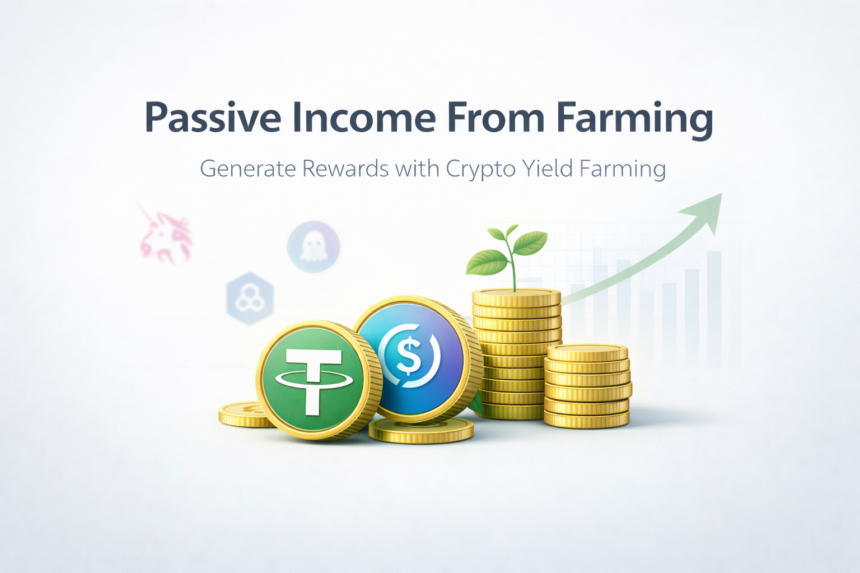
Yield farming has become one of the most popular ways to generate passive income in crypto. By providing liquidity or lending assets in decentralized finance platforms, investors can earn rewards without active trading.
In this guide, you will learn how passive income from farming works, how much you can earn, the risks involved, and how to build a steady farming strategy.
What Is Yield Farming?
Yield farming is a strategy where users deposit crypto assets into DeFi protocols to earn rewards.
It typically involves:
- Providing liquidity to decentralized exchanges
- Lending tokens to borrowers
- Staking LP tokens for extra rewards
Popular platforms include:
- Uniswap
- PancakeSwap
- Aave
Farmers earn trading fees, interest, and incentive tokens.
How Passive Income from Farming Works
Step 1: Deposit assets into a liquidity pool
Step 2: Receive LP tokens
Step 3: Stake LP tokens in a farm
Step 4: Earn rewards over time
Income depends on:
- Pool trading volume
- Token price stability
- Platform incentives
- Total liquidity in the pool
The more trading activity, the higher the potential fee income.
Types of Farming Income
1. Trading Fee Rewards
Liquidity providers earn a percentage of every trade in the pool.
2. Incentive Token Rewards
Platforms distribute native tokens to attract liquidity.
3. Lending Interest
On lending platforms, you earn interest from borrowers.
Example of Passive Income from Farming
Suppose you deposit 2000 USD into a stablecoin pool.
If the pool offers 10 percent APY:
- Annual income could be about 200 USD
- Rewards may compound if reinvested
If the APY is 25 percent:
- Potential income is higher
- Risk of token volatility increases
Higher returns usually come with higher risk.
Benefits of Yield Farming
- Generates passive income
- Works without active trading
- Flexible entry and exit
- Opportunity for compounding
Stablecoin pools can provide more predictable income compared to volatile token pairs.
Risks of Passive Farming
Impermanent Loss
Price changes between tokens can reduce profits.
Smart Contract Risk
Bugs or hacks can lead to loss of funds.
Reward Token Volatility
Incentive tokens may lose value.
Liquidity Risk
Low volume pools generate lower income.
Understanding these risks is essential before investing.
Stablecoin Farming for Steady Income
Stablecoin farming often uses assets such as:
- Tether
- USD Coin
Platforms like Curve Finance focus on stablecoin pools to reduce volatility risk.
Stablecoin farming is usually better for generating steady income.
How to Build a Sustainable Farming Strategy
- Start with stablecoin pools
- Avoid extremely high APY offers
- Diversify across platforms
- Monitor pool performance
- Reinvest rewards for compounding
- Keep emergency funds outside DeFi
Consistency matters more than chasing high yields.
Farming vs Staking for Passive Income
| Feature | Farming | Staking |
| Potential Returns | Higher | Moderate |
| Risk Level | Moderate to High | Low to Moderate |
| Impermanent Loss | Yes | No |
| Complexity | Higher | Simple |
| Best For | Active DeFi users | Long term holders |
Farming can generate higher returns but requires active risk management.
FAQ Section
Is yield farming truly passive income?
Yes, but it requires monitoring and occasional adjustments.
How much can I earn from farming?
Returns vary widely. Stable pools may offer 3 to 12 percent annually, while high risk farms can offer much more.
Is farming safe?
It involves smart contract and market risk. It is not risk free.
Can farming income be consistent?
Stablecoin farming tends to provide more stable income than volatile token pairs.
Should beginners try farming?
Beginners should start small and focus on stablecoin pools.
Passive Income from Farming in India
Crypto investors in India often prefer:
- Lower fee networks
- Stablecoin farming
- Moderate APY pools
Tax reporting and regulation should be carefully tracked.
Passive Income from Farming in USA
In the United States:
- Ethereum based DeFi platforms are popular
- Regulatory oversight is increasing
- Reporting farming rewards may be taxable
Compliance is important for long term sustainability.
Yield farming generates passive income by allowing users to provide liquidity or lend assets in DeFi platforms. Farmers earn trading fees, interest, and reward tokens.
Stablecoin pools offer steadier income, while volatile token farms may provide higher but riskier returns.
Final Verdict
Passive income from farming can be profitable if approached carefully.
For steady income:
Choose stablecoin pools and reputable platforms.
For higher growth:
Explore higher APY farms but manage risk actively.
Sustainable farming focuses on moderate returns, diversification, and consistent monitoring rather than chasing extreme yields.