

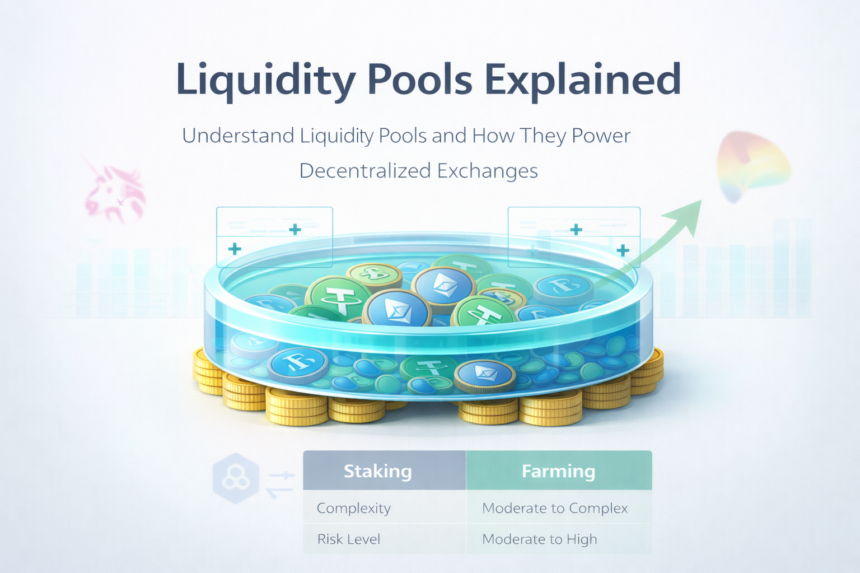
Liquidity pools are the backbone of decentralized finance. They power decentralized exchanges, enable token swaps, and allow users to earn passive income without traditional order books.
In this complete guide, you will understand what liquidity pools are, how they work, how they power decentralized exchanges, and the risks and rewards involved.
What Is a Liquidity Pool?
A liquidity pool is a collection of crypto tokens locked in a smart contract. These tokens provide liquidity for trading on decentralized exchanges.
Instead of matching buyers and sellers like traditional exchanges, decentralized exchanges use liquidity pools to enable instant token swaps.
Liquidity pools are commonly used on platforms such as:
- Uniswap
- PancakeSwap
- Curve Finance
How Do Liquidity Pools Work?
Liquidity pools use an Automated Market Maker model, often called AMM.
Here is how it works:
- Users deposit two tokens into a pool
- The pool maintains a price ratio between them
- Traders swap tokens against the pool
- Liquidity providers earn trading fees
For example:
If you deposit ETH and USDT into a pool, traders can swap ETH for USDT using your liquidity.
You earn a portion of the trading fees generated by the pool.
What Is an Automated Market Maker?
An Automated Market Maker is a smart contract that uses mathematical formulas to determine token prices.
The most common formula is:
x multiplied by y equals k
Where:
- x is token A
- y is token B
- k is a constant
This formula automatically adjusts prices based on supply and demand.
Why Are Liquidity Pools Important?
Liquidity pools power decentralized exchanges by:
- Removing the need for traditional order books
- Allowing permissionless trading
- Enabling instant swaps
- Supporting yield farming
- Creating decentralized lending markets
Without liquidity pools, decentralized finance would not function efficiently.
How Do You Earn from Liquidity Pools?
When you provide liquidity:
- You receive LP tokens
- You earn a percentage of trading fees
- You may earn additional farming rewards
Returns depend on:
- Trading volume
- Pool size
- Incentive programs
Stablecoin pools often provide more stable returns.
Example of a Liquidity Pool
On Uniswap:
- A user deposits ETH and USDT
- Traders swap between ETH and USDT
- The provider earns fees from each trade
On Curve Finance:
- Users deposit stablecoins
- Impermanent loss is reduced
- Returns are more stable
Risks of Liquidity Pools
1. Impermanent Loss
This happens when one token in the pair changes price significantly. Your total value may become lower than simply holding both tokens separately.
2. Smart Contract Risk
Liquidity pools rely on smart contracts. Bugs or exploits can lead to loss of funds.
3. Token Volatility
High volatility pairs can increase risk.
4. Low Liquidity Risk
Small pools can experience slippage and price manipulation.
Liquidity Pools vs Traditional Exchanges
| Feature | Liquidity Pools | Traditional Exchange |
| Order Book | No | Yes |
| Central Authority | No | Yes |
| Custody | User controlled | Exchange controlled |
| Pricing | Algorithm based | Market driven bids |
| Permission Required | No | Yes |
Liquidity pools enable fully decentralized trading.
Who Should Use Liquidity Pools?
Liquidity pools are best for:
- Long term crypto holders
- Users seeking passive income
- DeFi enthusiasts
- Investors comfortable with risk
Beginners should start with stablecoin pools before trying volatile token pairs.
FAQ Section
What is the main purpose of liquidity pools?
Liquidity pools provide tokens for decentralized trading and enable instant swaps.
Do liquidity pools guarantee profit?
No. Impermanent loss and market volatility can reduce returns.
What are LP tokens?
LP tokens represent your share of the liquidity pool.
Are liquidity pools safe?
They carry smart contract and market risks.
What is impermanent loss?
It is a temporary loss that occurs when token prices change compared to holding them separately.
Liquidity Pools in India
Crypto users in India often use:
- BNB Smart Chain platforms due to lower fees
- Stablecoin pools for reduced volatility
Tax reporting on DeFi income should be monitored carefully.
Liquidity Pools in USA
In the United States:
- Ethereum based pools are popular
- Regulatory clarity is evolving
- Compliance and reporting are important
Always verify platform reliability.
Liquidity pools are smart contract based token reserves that power decentralized exchanges. They allow users to swap tokens without traditional order books and enable liquidity providers to earn trading fees.
Final Verdict
Liquidity pools are essential to decentralized finance. They enable permissionless trading and create passive income opportunities for liquidity providers.
However, risks such as impermanent loss and smart contract vulnerabilities must be carefully considered.
If you understand the mechanics and manage risk properly, liquidity pools can be a powerful tool in your crypto investment strategy.
Impermanent Loss Explained /impermanent-loss Impermanent Loss Explained Learn what impermanent loss is and how it affects liquidity providers. create for this