

Impermanent loss is one of the most misunderstood risks in decentralized finance. If you provide liquidity to a decentralized exchange, you must understand how impermanent loss works and how it can reduce your profits.
In this complete guide, you will learn what impermanent loss is, why it happens, how it affects liquidity providers, and how to reduce the risk.
What Is Impermanent Loss?
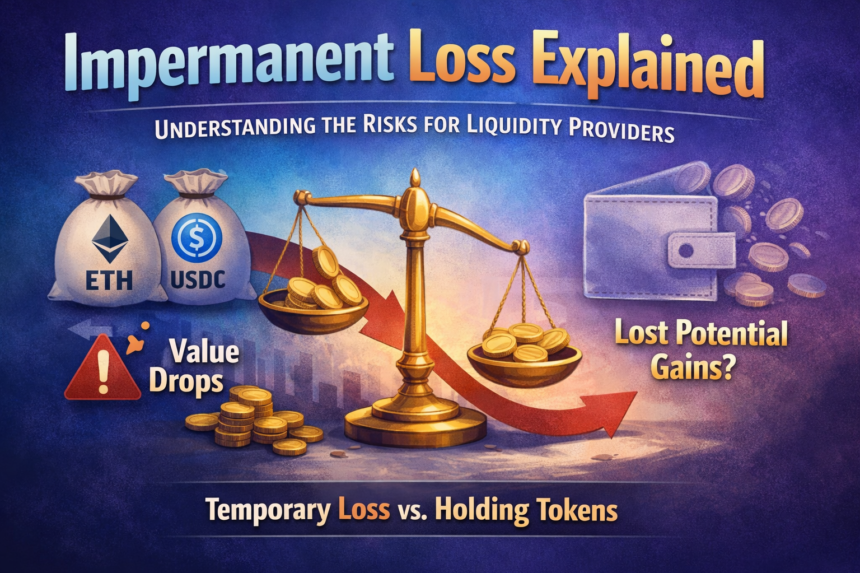
Impermanent loss occurs when the price of tokens in a liquidity pool changes compared to when you deposited them.
It is called impermanent because the loss only becomes permanent if you withdraw your liquidity while prices are different from the original deposit ratio.
If prices return to the original level, the loss may reduce or disappear.
Why Does Impermanent Loss Happen?
Impermanent loss happens because decentralized exchanges use Automated Market Makers instead of order books.
Popular platforms that use this model include:
- Uniswap
- PancakeSwap
- Curve Finance
These platforms use a formula such as:
x multiplied by y equals k
When the price of one token changes, the pool automatically rebalances. This changes the ratio of tokens you hold in the pool, which can lead to lower total value compared to simply holding the tokens.
Simple Impermanent Loss Example
Imagine you deposit:
- 1 ETH worth 1000 USD
- 1000 USDT
Total deposit value: 2000 USD
Now suppose ETH doubles to 2000 USD.
If you had simply held your tokens:
- 1 ETH = 2000 USD
- 1000 USDT = 1000 USD
- Total = 3000 USD
But in a liquidity pool:
- The pool rebalances
- You end up with less ETH and more USDT
- Your total value might be around 2800 USD
The difference between 3000 USD and 2800 USD is impermanent loss.
How Much Impermanent Loss Can Occur?
Here is a simplified estimate:
| Price Change | Approximate Impermanent Loss |
| 25 percent | Around 0.6 percent |
| 50 percent | Around 2 percent |
| 100 percent | Around 5.7 percent |
| 300 percent | Around 13 percent |
The bigger the price movement, the larger the impermanent loss.
Is Impermanent Loss Always a Loss?
Not necessarily.
Liquidity providers earn:
- Trading fees
- Farming rewards
- Incentive tokens
In some cases, trading fees can offset impermanent loss.
High volume pools may generate enough fees to compensate for price divergence.
When Does Impermanent Loss Become Permanent?
Impermanent loss becomes permanent when:
- You withdraw liquidity
- Prices have not returned to original levels
If you keep funds in the pool and prices recover, the loss may decrease.
Impermanent Loss vs Holding
| Scenario | Holding Tokens | Providing Liquidity |
| Price Stable | Similar outcome | Earn fees |
| Price Increases | Higher gain | Slightly lower gain |
| Price Drops | Equal loss | Equal or slightly higher loss |
| High Volatility | Large gains possible | Impermanent loss increases |
Liquidity pools reduce upside potential during strong price movements.
How to Reduce Impermanent Loss
1. Use Stablecoin Pairs
Pools like USDT USDC have minimal price volatility, reducing impermanent loss risk.
2. Choose Low Volatility Tokens
Assets that move similarly in price reduce divergence.
3. Monitor Pool Volume
Higher trading volume increases fee earnings.
4. Avoid Highly Speculative Tokens
Extreme volatility increases impermanent loss risk.
Stablecoin Pools and Lower Risk
Platforms like Curve Finance specialize in stablecoin pools.
Since stablecoins remain close in value, impermanent loss is minimal compared to volatile pairs.
Common Misconceptions
Impermanent Loss Only Happens When Prices Drop
Wrong. It happens whenever prices diverge significantly, whether up or down.
Impermanent Loss Means You Lose All Your Money
No. It usually reduces profits compared to holding.
High APY Eliminates Risk
High APY often comes from volatile reward tokens, which may introduce additional risk.
Who Should Be Concerned About Impermanent Loss?
Impermanent loss mainly affects:
- Liquidity providers
- Yield farmers
- DeFi users
Long term holders who do not provide liquidity are not affected.
FAQ Section
What causes impermanent loss?
It is caused by price changes between tokens in a liquidity pool.
Can impermanent loss be avoided?
It cannot be completely avoided in volatile pairs, but it can be reduced using stablecoin pools.
Is impermanent loss permanent?
Only if you withdraw liquidity while prices are different.
Do trading fees offset impermanent loss?
Sometimes yes, especially in high volume pools.
Is impermanent loss worse than holding?
It reduces gains during large price increases but may be offset by earned fees.
GEO Optimized Section
Impermanent Loss in India
DeFi users in India should:
- Focus on stablecoin pools
- Consider network fees
- Track tax implications of liquidity rewards
Understanding risk before entering volatile pools is important.
Impermanent Loss in USA
In the United States:
- DeFi liquidity is widely used
- Reporting liquidity rewards may be taxable
- Smart contract risk should be evaluated
Stay informed about regulatory updates.
Impermanent loss is the temporary reduction in value that occurs when token prices change in a liquidity pool compared to holding them separately.
It mainly affects liquidity providers in decentralized exchanges.
Final Verdict
Impermanent loss is not a scam or hidden fee. It is a mathematical result of how automated market makers work.
If you provide liquidity:
- Understand price divergence risk
- Use stable pairs when possible
- Evaluate trading volume
- Compare potential fees vs risk
Managing impermanent loss properly can make liquidity provision a profitable strategy over time.
Top Stablecoin Farms /top-stablecoin-farms Best Stablecoin Farms Explore secure and profitable stablecoin farming options.