
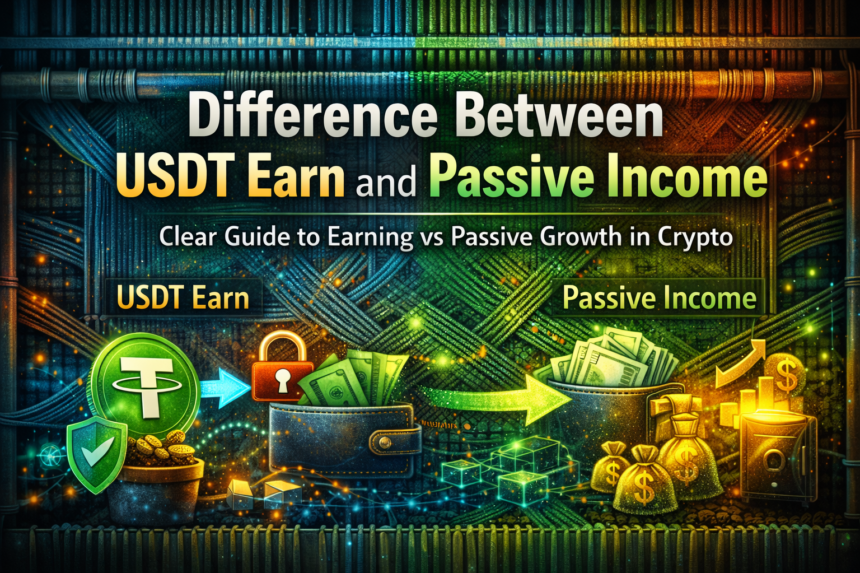
Many crypto investors use the terms USDT Earn and passive income interchangeably. However, they are not exactly the same. Understanding the difference helps you choose the right strategy based on your risk tolerance, time commitment, and financial goals.
In this complete guide, you will learn the difference between USDT Earn products and broader passive income opportunities using USDT, along with examples, risks, and best use cases.
What Is USDT?
Tether (USDT) is a stablecoin pegged to the US dollar. It is widely used for trading, lending, liquidity farming, and earning yield in both centralized and decentralized platforms.
Because USDT maintains a relatively stable price, it is popular for generating income without exposure to crypto market volatility.
What Is USDT Earn?
USDT Earn typically refers to structured earning products offered by centralized exchanges such as:
- Binance
- Bybit
- KuCoin
These platforms provide built in earning tools under sections often labeled Earn, Savings, or Staking.
Common USDT Earn Products
- Flexible savings
- Locked staking
- Fixed term deposits
- Dual investment products
- Launchpool rewards
Key Characteristics
- Managed by the exchange
- Requires KYC
- Platform holds custody of funds
- Returns are clearly displayed
- Easy for beginners
USDT Earn is usually simple and low effort.
What Is Passive Income with USDT?
Passive income with USDT is a broader concept. It includes any strategy where your USDT generates income without active daily trading.
This can include:
- DeFi lending
- Yield farming
- Liquidity providing
- Copy trading
- Crypto arbitrage bots
- Peer to peer lending
Unlike exchange Earn products, passive income strategies may require:
- Wallet management
- Smart contract interaction
- Risk evaluation
- Active monitoring
Key Differences Between USDT Earn and Passive Income
| Feature | USDT Earn | USDT Passive Income |
| Platform Type | Centralized exchanges | Centralized and DeFi |
| Complexity | Very simple | Moderate to advanced |
| Custody | Exchange holds funds | User controlled or platform dependent |
| Risk Level | Lower to moderate | Moderate to high |
| Flexibility | Structured products | Wide range of strategies |
| Control | Limited | Higher control in DeFi |
Types of USDT Passive Income Opportunities
1. Centralized Earn Programs
These are structured products inside exchanges. Lower complexity, moderate returns.
2. DeFi Lending Protocols
Platforms like Aave allow users to deposit USDT and earn interest from borrowers.
Pros:
- Non custodial
- Transparent rates
Cons:
- Smart contract risk
- Gas fees
3. Liquidity Farming
Users provide USDT paired with another token in liquidity pools to earn trading fees and rewards.
Risk factors:
- Impermanent loss
- Reward token volatility
- Smart contract vulnerabilities
4. P2P Lending
You lend USDT directly to other users through exchange P2P platforms.
Pros:
- Higher interest potential
Cons:
- Counterparty risk
- Platform mediation required
Which Option Is Safer?
USDT Earn on centralized exchanges is generally safer for beginners because:
- It is easier to use
- Risks are more controlled
- Returns are predictable
Passive income through DeFi may offer higher returns, but carries:
- Smart contract risk
- Liquidity risk
- Regulatory risk
Higher returns usually mean higher risk.
Risk Comparison
Custodial Risk
Centralized Earn products expose you to exchange risk.
Smart Contract Risk
DeFi platforms rely on code that can be exploited.
Yield Volatility
Passive income strategies often have fluctuating APY.
Regulatory Risk
Stablecoin regulation may impact both models.
Best Strategy for Beginners
If you are new:
- Start with flexible savings on a trusted exchange
- Avoid extremely high APY
- Diversify across multiple platforms
- Reinvest profits gradually
FAQ Section
Is USDT Earn truly passive income?
Yes, but it is a structured version of passive income managed by exchanges.
Which gives higher returns?
DeFi farming and advanced strategies often offer higher returns but with higher risk.
Can I lose money in USDT Earn?
Yes. Exchange insolvency or platform failure can cause loss.
Is DeFi better than exchange Earn?
DeFi offers more control, but requires more knowledge and risk management.
What is the safest way to earn passive income with USDT?
Moderate yield savings on reputable exchanges are generally safer for beginners.
USDT Passive Income in India
Investors in India often prefer centralized Earn products due to:
- Easy INR conversion
- Exchange support
- Simpler tax reporting
Always monitor crypto tax compliance locally.
USDT Passive Income in USA
In the United States:
- Some centralized Earn products may be restricted
- DeFi platforms are commonly used
- Regulatory clarity is evolving
Always check platform compliance.
USDT Earn refers to exchange based structured earning products. Passive income with USDT includes a broader range of strategies such as DeFi lending, farming, and P2P lending.
USDT Earn is simpler and beginner friendly. Passive income strategies can offer higher returns but carry higher risk.
Final Verdict
USDT Earn is a simplified version of passive income, mainly offered by centralized exchanges.
Passive income with USDT includes both centralized and decentralized strategies that vary in risk and complexity.
If you want ease and stability, choose USDT Earn.
If you want flexibility and potentially higher returns, explore broader passive income opportunities carefully.
Always evaluate risk before investing and avoid chasing unrealistic yields.
Disclaimer:
The information provided in this article is for general informational and educational purposes only and does not constitute financial, investment, tax, or legal advice. Cryptocurrency networks, transaction fees, transfer speeds, and associated risks can change rapidly and may vary by platform or jurisdiction. Readers should conduct their own research and consult with a qualified financial advisor before making any decisions related to digital assets or blockchain transactions.