
If you want to earn passive income in crypto, you have likely come across staking and farming. Both strategies allow you to generate rewards, but they work very differently and carry different levels of risk.
In this complete guide, we compare staking vs farming, explain how each works, analyze risks and returns, and help you decide which option is better for your investment goals.
What Is Staking?
Staking involves locking your crypto assets in a blockchain network to support its operations and security. In return, you earn rewards.
Staking is common in Proof of Stake blockchains such as:
- Ethereum
- BNB Smart Chain
- Solana
How Staking Works
- You lock tokens in a validator
- The network uses them to validate transactions
- You earn staking rewards
Typical Returns
Generally between 3 percent and 15 percent annually depending on the network.
What Is Yield Farming?
Yield farming involves providing liquidity to decentralized finance platforms to earn trading fees and reward tokens.
Popular farming platforms include:
- Aave
- Uniswap
- PancakeSwap
How Farming Works
- You deposit token pairs into liquidity pools
- Traders use the pool for swaps
- You earn fees and incentives
Typical Returns
Can range from 5 percent to over 100 percent annually, depending on risk.
Staking vs Farming: Key Differences
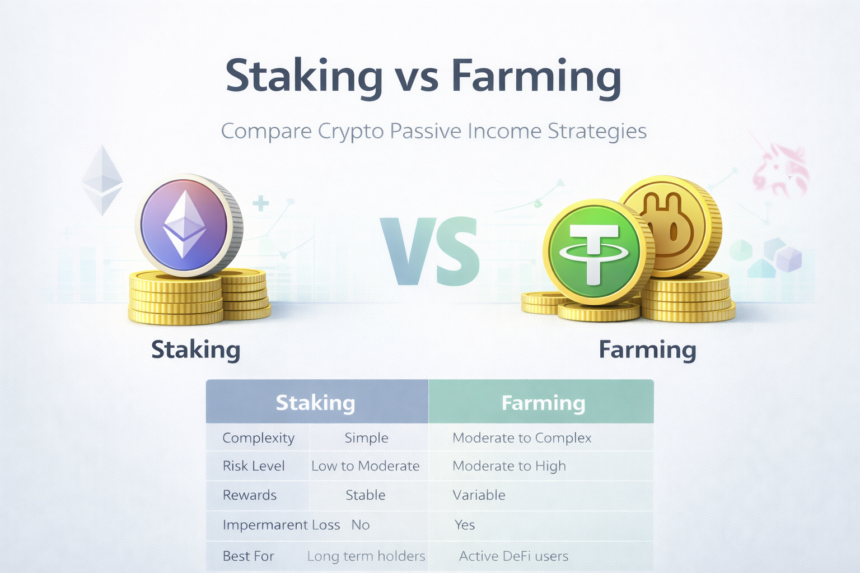
| Feature | Staking | Farming |
| Complexity | Simple | Moderate to complex |
| Risk Level | Low to moderate | Moderate to high |
| Rewards | Stable | Variable |
| Impermanent Loss | No | Yes |
| Smart Contract Risk | Low | High |
| Best For | Long term holders | Active DeFi users |
Risk Comparison
1. Staking Risks
- Token price volatility
- Lockup periods
- Validator slashing penalties
- Network risk
Staking is generally considered lower risk compared to farming.
2. Farming Risks
- Impermanent loss
- Smart contract vulnerabilities
- Reward token price collapse
- Liquidity risk
Higher APY usually means higher risk in farming.
Return Comparison
Staking:
- More predictable returns
- Lower volatility
- Ideal for conservative investors
Farming:
- Potentially higher APY
- Rewards may fluctuate daily
- Requires active monitoring
If you want stable and consistent earnings, staking may be better.
If you want higher potential returns and can manage risk, farming may offer more opportunity.
Which Is Better for Beginners?
Beginners should start with staking because:
- It is simpler
- Lower technical complexity
- No impermanent loss
- Easier to understand reward structure
Farming requires understanding liquidity pools and DeFi risks.
When Is Farming Better?
Farming may be better when:
- You understand DeFi mechanics
- You can manage impermanent loss
- You are comfortable with smart contract risk
- You want higher short term yields
Example Scenario
If you stake 1000 USD worth of tokens at 8 percent annual return:
- You earn approximately 80 USD per year.
If you farm liquidity with 25 percent APY:
- You could earn 250 USD annually
- But impermanent loss or token price drop could reduce profits.
Higher rewards come with higher uncertainty.
Centralized vs Decentralized Options
Some exchanges like Binance offer both staking and farming products under their Earn section.
Pros:
- Easier interface
- No wallet setup required
Cons:
- Custodial risk
- Limited transparency
DeFi platforms offer full control but require wallet management.
FAQ Section
Is staking safer than farming?
Yes, staking is generally considered safer because it does not involve impermanent loss.
Can farming give higher returns than staking?
Yes, but it carries higher risk and volatility.
Do I need two tokens for farming?
Usually yes. Most liquidity pools require token pairs.
Can staking rewards decrease?
Yes. Staking rewards depend on network participation and inflation rate.
Which is better long term?
For long term stability, staking is often better. For aggressive growth, farming may offer higher returns.
Staking vs Farming in India
Crypto users in India often prefer:
- Staking through centralized exchanges
- Lower fee networks
- Moderate risk strategies
Tax reporting and regulation should be monitored.
Staking vs Farming in USA
In the United States:
- Staking is widely used
- DeFi farming is popular but regulated carefully
- Compliance and reporting are important
Staking involves locking tokens to secure a blockchain and earn stable rewards.
Farming involves providing liquidity to DeFi platforms and earning variable, often higher returns.
Staking is safer and simpler. Farming offers higher potential returns but higher risk.
Final Verdict
If you want predictable income with lower complexity, staking is the better option.
If you are experienced and willing to manage higher risk for higher rewards, farming can be more profitable.
Your ideal choice depends on risk tolerance, technical knowledge, and investment goals.
What Are Liquidity Pools /liquidity-pools-explained Liquidity Pools Explained Understand liquidity pools and how they power decentralized exchanges. create for this also