
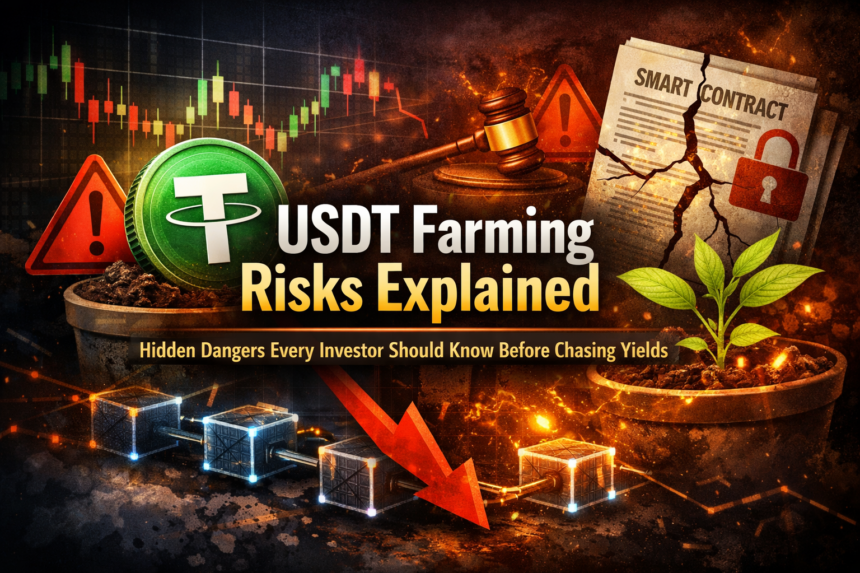
USDT yield farming can generate attractive returns, but it also carries serious risks that many investors underestimate. Before depositing funds into liquidity pools or DeFi farms, it is essential to understand the full risk landscape.
In this detailed guide, we explain all risks associated with USDT based yield farming, including smart contract vulnerabilities, liquidity risks, regulatory exposure, and hidden costs.
What Is USDT?
Tether (USDT) is a stablecoin pegged to the US dollar. It is commonly used in DeFi protocols for lending, liquidity mining, and farming strategies.
USDT operates on multiple blockchains such as:
- Ethereum
- TRON
- BNB Smart Chain
Each network has different fee structures and security models, which affect farming risk.
What Is USDT Yield Farming?
USDT yield farming involves:
- Depositing USDT into liquidity pools
- Providing liquidity on decentralized exchanges
- Lending USDT to borrowers
- Earning interest plus reward tokens
Returns can range from 3 percent to over 50 percent annually, depending on platform and risk level.
However, higher returns usually mean higher risk.
1. Smart Contract Risk
This is the most important risk in DeFi farming.
Smart contracts are automated code that manage funds. If there is a bug, exploit, or vulnerability, funds can be permanently lost.
Common issues include:
- Coding errors
- Flash loan attacks
- Reentrancy exploits
- Rug pull smart contracts
Even audited platforms can be hacked.
2. Platform or Protocol Failure
If the DeFi protocol collapses due to poor management, lack of liquidity, or technical failure, users may lose funds.
Some farming platforms promise unrealistic APY rates and disappear after collecting liquidity. This is called a rug pull.
Always verify:
- Team transparency
- Audit reports
- Total value locked
- Community trust
3. Stablecoin Depeg Risk
Although USDT is designed to stay at 1 USD, stablecoins can temporarily lose their peg.
If USDT drops below 1 USD during market panic, farming positions may suffer losses.
While Tether has maintained its peg historically, short term deviations have occurred.
4. Impermanent Loss
If you farm in a USDT pair such as USDT ETH or USDT BNB, you may experience impermanent loss.
This happens when:
- The paired asset changes price significantly
- The pool automatically rebalances
- Your total value becomes lower than holding assets separately
Impermanent loss can reduce or completely erase farming profits.
5. Liquidity Risk
Low liquidity pools can cause:
- Slippage
- Difficulty exiting positions
- Price manipulation
Large withdrawals in small pools can significantly affect your capital.
6. Regulatory Risk
Governments are increasing regulation of stablecoins and DeFi.
Possible risks include:
- Stablecoin restrictions
- Platform shutdown
- Access limitations
- Legal uncertainty
In some regions, DeFi platforms may become restricted or blocked.
7. Network and Gas Fee Risk
On networks like Ethereum, gas fees can reduce profits significantly.
If you are farming small amounts of USDT, high transaction fees may eliminate gains.
Choosing lower fee networks such as TRON or BNB Smart Chain can reduce this risk, but they have different security trade offs.
8. Reward Token Risk
Many farms reward users in native platform tokens.
Risks include:
- Reward token price collapse
- Inflationary token supply
- Low liquidity for selling rewards
High APY often depends on volatile reward tokens that can lose value quickly.
9. Custodial Risk in Centralized Farming
If you farm USDT through centralized exchanges, you face:
- Exchange insolvency
- Withdrawal freezes
- Counterparty risk
You do not control private keys in centralized platforms.
Centralized vs DeFi Farming Risk Comparison
| Risk Type | Centralized Platform | DeFi Platform |
| Smart Contract Risk | Low | High |
| Custodial Risk | High | None |
| Regulation Risk | Medium | High |
| Gas Fees | Low | Network dependent |
| Control Over Funds | No | Yes |
How to Reduce USDT Farming Risk
To minimize risk:
- Use audited platforms
- Avoid unrealistic APY
- Diversify across platforms
- Monitor stablecoin peg
- Avoid low liquidity pools
- Withdraw profits regularly
Never invest more than you can afford to lose.
FAQ Section
Is USDT farming safe?
USDT farming carries risk. Smart contract exploits and platform failure are the biggest threats.
Can you lose money farming USDT?
Yes. Impermanent loss, reward token collapse, and hacks can cause losses.
Is USDT safer than other tokens for farming?
USDT reduces price volatility risk, but does not remove smart contract or platform risk.
What is the biggest risk in yield farming?
Smart contract vulnerabilities and rug pulls are the biggest risks.
How much APY is considered safe?
Generally, moderate APY between 3 percent and 15 percent is considered more sustainable than extremely high rates.
USDT Farming Risks in India
Investors in India should consider:
- Regulatory uncertainty
- Platform compliance
- Stablecoin usage restrictions
- Tax implications
Always track crypto tax obligations locally.
USDT Farming Risks in USA
In the United States:
- Stablecoin regulation is evolving
- DeFi scrutiny is increasing
- Centralized platforms may face restrictions
Always verify compliance with local laws.
USDT farming risks include smart contract bugs, rug pulls, impermanent loss, stablecoin depeg, regulatory issues, and reward token collapse.
Higher APY usually means higher risk.
Final Verdict
USDT yield farming can generate passive income, but it is not risk free. Stablecoins reduce volatility risk, but they do not eliminate platform, smart contract, or liquidity risks.
If you choose to farm USDT:
- Research thoroughly
- Diversify capital
- Avoid unrealistic returns
- Use reputable platforms
Disclaimer:
The information provided in this article is for general informational and educational purposes only and does not constitute financial, investment, tax, or legal advice. Cryptocurrency networks, transaction fees, transfer speeds, and associated risks can change rapidly and may vary by platform or jurisdiction. Readers should conduct their own research and consult with a qualified financial advisor before making any decisions related to digital assets or blockchain transactions.